All about the History of the Smash Burger!
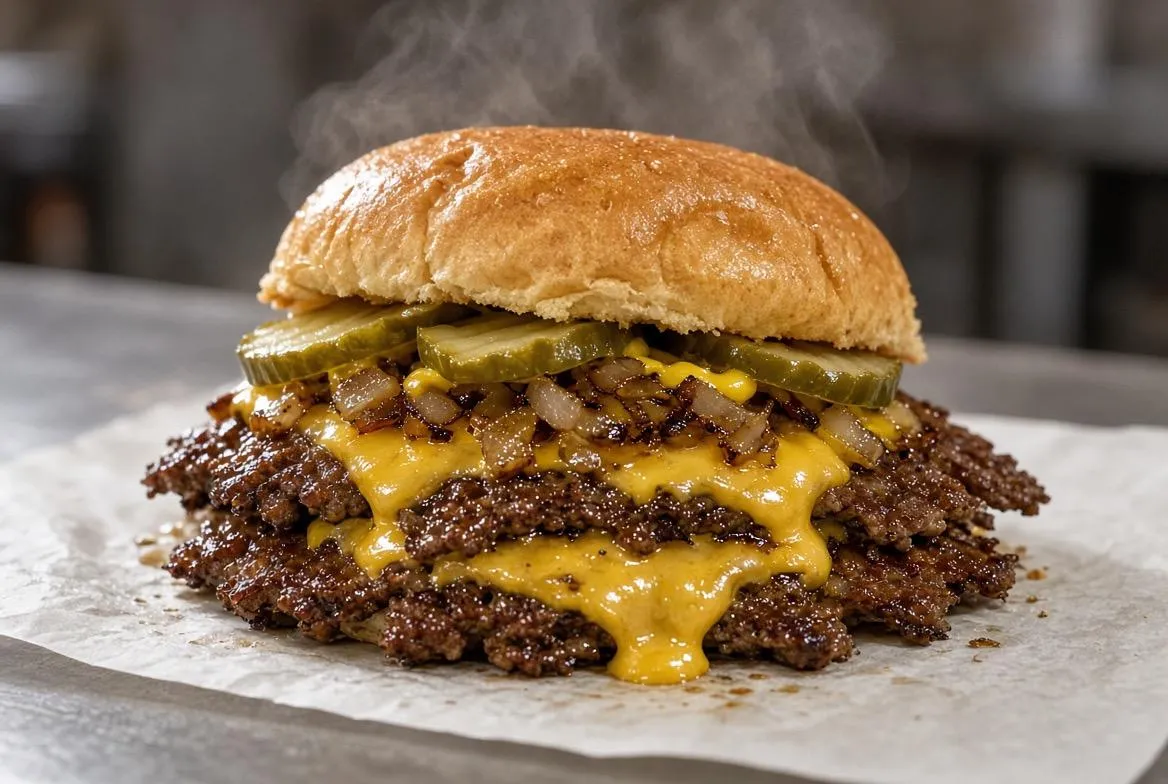
There is no single inventor of the smash burger. Historians treat it as a diner technique that evolved in the United States, then got a modern name and a second life as a trend. The honest story is a stack of overlapping Midwestern and Southern practices, not one restaurant’s “first.”
What a smash burger actually is
A smash burger starts as a loose ball of ground beef, not a pre-formed thick patty. That ball hits a very hot flat-top griddle and is pressed hard—once, early—so it spreads thin. The point is surface area: more meat touching the steel means more browning, lacy crisp edges, and the Maillard reaction that makes it taste toasted and savory instead of just “grilled.” Cheese often melts on the second side. Classic toppings stay simple: American cheese, onions, pickles, mustard, a soft bun. 
The earliest layer: speed, not branding
Burger historian George Motz argues that some of the first American hamburgers—sold at fairs and factory gates in the late 1800s and early 1900s—were already thin patties pressed into pans because cooks had to feed people fast. Those early pressed burgers were not necessarily the ultra-crispy, lace-edged version people post online today. Motz dates that crisp style closer to the late 1920s and early 1930s, after restaurant flattops added grease traps so fat could run off instead of frying the patty in its own grease. 
Oklahoma’s onion smash: the Depression-era cousin
A closely related and well-documented ancestor is the Oklahoma fried onion burger. Around 1922–1926, Ross Davis at the Hamburger Inn in El Reno, Oklahoma (on Route 66) stretched expensive beef with cheap sliced onions, then smashed the onions into the meat on the grill. The usual story places this during hard times for railroad workers and, later, the Great Depression: less meat, more onion, still a filling sandwich sold cheap. El Reno still treats the onion burger as local heritage. Many modern smash burgers quietly descend from this idea even when they skip the mountain of onions. 
Indiana and Illinois diners keep the method alive
Miner-Dunn, which opened in 1932 and later settled in Highland, Indiana, is often cited as a place that has served smashed-style burgers for nearly a century. In 1948 Allen Schoop bought a former Miner-Dunn space in Hammond, Indiana, and kept the thin-smash tradition going. 
Steak ’n Shake opened in February 1934 in Normal, Illinois, founded by Gus and Edith Belt. Gus ground steak cuts in front of customers (“In Sight It Must Be Right”) and cooked thin “steakburgers” with crisp edges on a flattop. That Midwest diner style—thin, fast, browned, stacked—is one of the main bridges between old short-order cooking and later smash culture. Shake Shack founder Danny Meyer, who grew up around St. Louis, has cited Steak ’n Shake as an influence. 
Carl’s Drive-In in Brentwood, near St. Louis, started smashing burgers after Carl Meyer bought the place in 1959. It became another Midwestern shrine for the thin, griddled patty. 
Dairy Cheer and the bean-can story
The most repeated “named invention” story comes from Dairy Cheer in Ashland, Kentucky. Owner Bill Culvertson had split from Dairy Queen so he could serve burgers. In the 1950s or 1960s (sources disagree on the exact decade), a cook reportedly used a bean can to press a beef ball onto the griddle. Culvertson liked the crust and put the style on the menu. Dairy Cheer later claimed a role in the name “smashburger” and, in 2010, sued the Denver chain Smashburger over trademark; the case settled. Historians treat Dairy Cheer as important popularization and naming lore, not as proof that no one smashed burgers earlier. 
The name and the chain: Smashburger, 2007
The Denver chain Smashburger did not invent the technique. Founders Tom Ryan (formerly of Pizza Hut and McDonald’s concept work) and Rick Schaden bought a small Denver diner called Icon Burger in 2006, tested a high-heat smash method, and opened the first Smashburger in 2007. Internally they already called the product smashburgers; research with “heavy burger lovers” pushed them to use that name on the door. The chain scaled the word nationally and later internationally. Ryan has said he popularized the method and the brand, not the idea itself. Jollibee later acquired the company. 
The 2000s–2010s revival
While Smashburger branded the word, Shake Shack (first permanent shop 2004, after a 2001 Madison Square Park cart) helped make a pressed, griddled diner burger fashionable again in the “better burger” wave alongside Five Guys. In 2012, writer-cook J. Kenji López-Alt published an influential Serious Eats piece arguing for the smash technique and explaining the science of the crust. That article is often credited with teaching home cooks and chefs why the thin smash works. 
The 2020s boom
TikTok and Instagram made the lacy edge a visual signature. Independent smash shops and pop-ups spread in the U.S., then the U.K., Australia, and beyond. Variations multiplied: Oklahoma onion smashes, double and triple stacks, smash-burger tacos (an older idea with a new viral life), hot-honey versions, and pub-menu smash burgers like the ones at places such as Riip in Huntington Beach. George Motz opened Hamburger America in New York as a deliberately old-school smashed-patty diner, calling that style the “primary-source” American burger. 
What did not happen
• Smashburger the chain did not invent smash burgers.
• There is no clean 1920s patent or single “patient zero.”
• Thick steakhouse burgers and smash burgers are different traditions; the smash style is the older everyday diner method that later looked new because thick pub burgers had taken over menus.
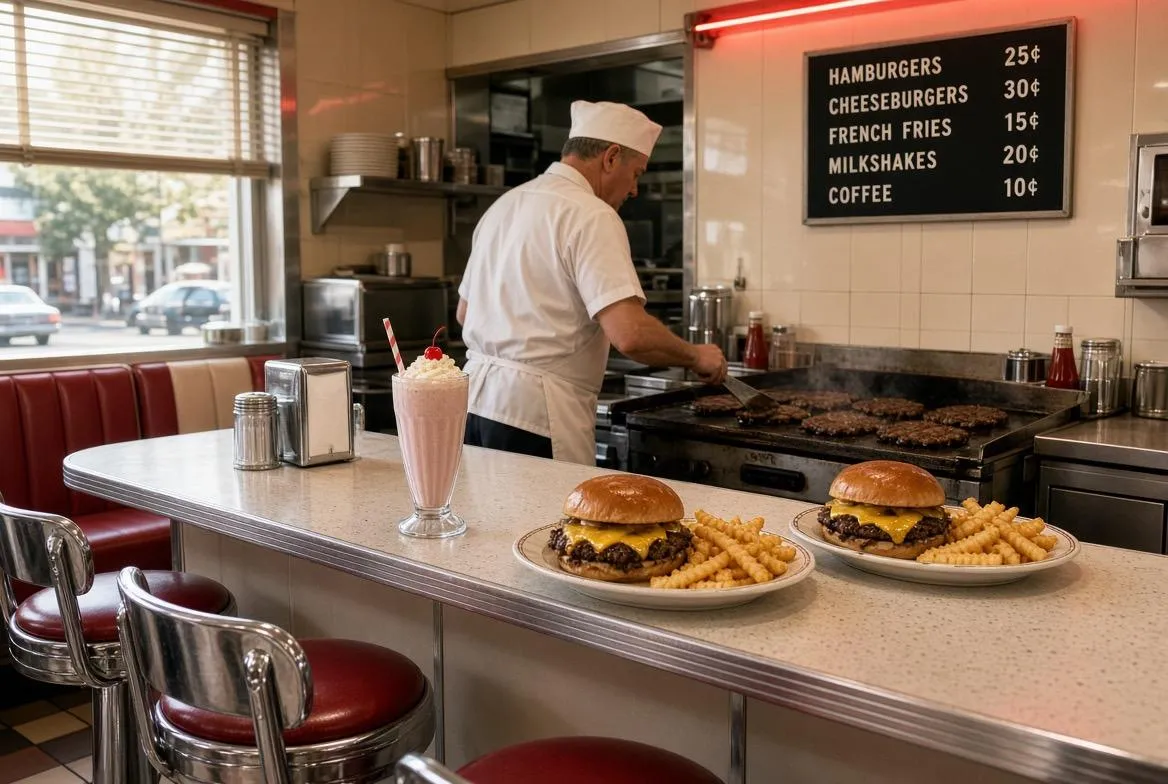
The through-line is practical, not fancy: smash the meat so it cooks faster, browns harder, and—when onions are cheap and beef is not—feeds more people. The viral burger of the 2020s is that old diner method with better beef, better photography, and a name a 2007 chain made famous.
Classic smash burgers are built to stay out of the way of the crust. The toppings are usually few, cheap, and diner-simple.
The core diner build
Most historical smash burgers are some version of this:
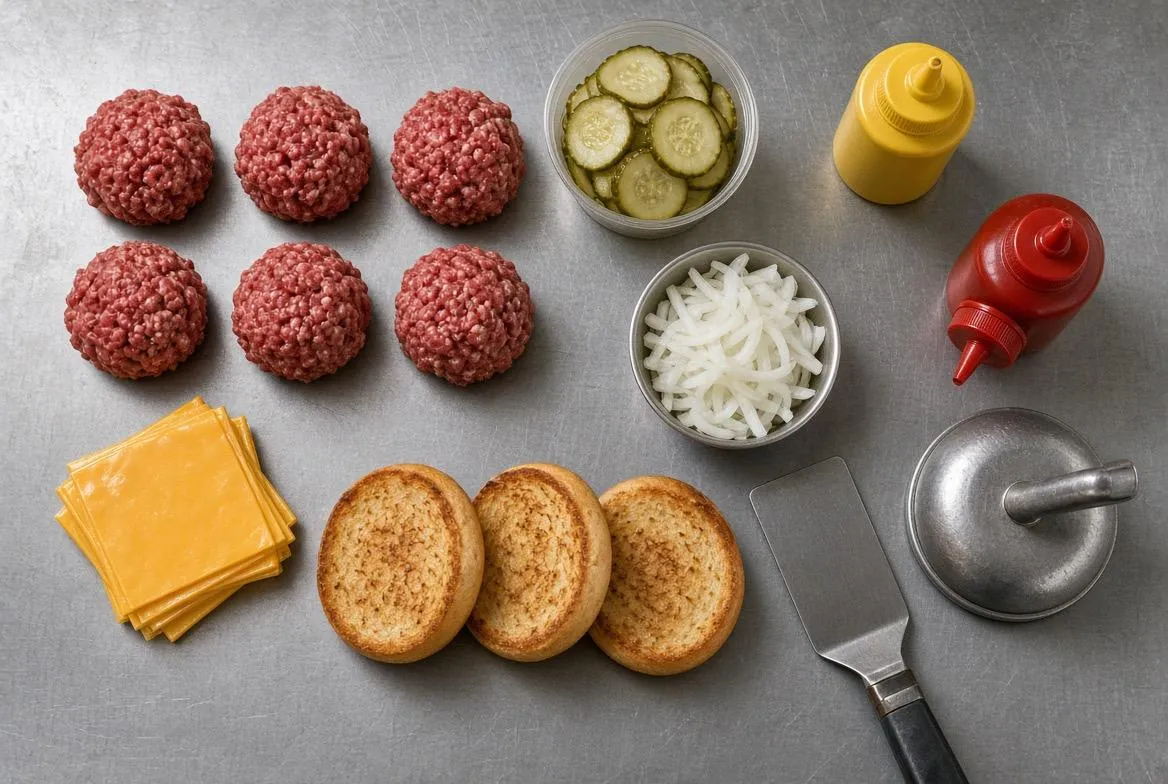
• Bun: Soft and slightly sweet so it can take grease without falling apart. Potato rolls and milk rolls are the American standard. Toasted on the same flattop is common.
• Beef: One or two thin smashed patties, high fat (often around 20–30%), salted on the griddle. The lacy browned edge is the point.
• Cheese: American cheese almost always. It melts fast, drapes the thin patty, and binds a double stack.
• Pickles: Dill chips. Sharp and cold against the fat.
• Onion: Either raw thin slices, griddled onions, or onions smashed into the meat (the Oklahoma style).
• Sauce: Yellow mustard is the old-school default. Ketchup shows up. Many modern shops use a “burger sauce” (mayo, ketchup, pickle, sometimes mustard).
That is the sandwich the technique was invented to carry: meat crust, melted cheese, pickle, onion, soft bun.
The Oklahoma onion smash
This is the oldest clearly named regional version. Onions are not a topping so much as part of the patty:
• Thin-sliced yellow or white onions piled on the raw beef
• Smashed into the meat on the griddle until they wilt, brown, and fuse to the crust
• Often finished with American cheese, pickles, and mustard
• Historically sometimes just beef, onion, and bun
The onion-to-beef ratio was originally a Depression stretch. Today it is kept because the onions caramelize into the crust.
What famous versions put on them
Steak ’n Shake steakburger: Thin smashed steak-blend patties, often doubled or tripled, American and/or Swiss, simple condiments, historically a sourdough-style bun on some items.
Shake Shack ShackBurger: Smashed-style patty, American cheese, lettuce, tomato, ShackSauce on a potato bun. That lettuce-and-tomato layer is a later “better burger” addition, not the 1930s diner default.
Smashburger chain: Hand-smashed Angus beef, cheese, and then build-your-own toppings; the brand made smash the method, not one fixed topping list.
Modern shop smash (including places like Riip): Double smash, American cheese, pickles, grilled onions or raw onion, house sauce on a potato bun. Bacon, hot honey, jalapeños, and extra stacks are add-ons, not the original form.
What usually stays off a traditional smash
Thick steakhouse toppings fight the style. A “pure” smash is rarely loaded with:
• A tall pile of lettuce and tomato (common now, less so historically)
• Fancy aiolis as the only identity
• A thick pub patty pretending to be smashed
• Too many wet toppings that soak the thin crust
The burger is supposed to taste like browned beef first. Cheese, pickle, onion, and mustard are there to cut fat and add snap, not to hide the griddle work.
The deep assurance that comes from full alignment
LEARN ABOUT OTHER FAMOUS OLD TOWNS: Old Town San Diego, Old Towne Orange, Old Town San Clemente, Old Town Monrovia, Old Town Temecula, Old Town Pasadena, Old Town Sacramento, Old Town Bern, Old Town Stockholm, Old Town Prague, Old Town Lijiang, Old Town Alexandria, Old Town Albuquerque, Old Town Cottonwood, Old Town Quedlinburg, Old Town Rothenburg ob der Tauber, Old Town Marienplatz Munich, Flipside Point, Alexanderplatz Old Town Berlin, Old Town Chicago, Old Town Kissimmee Florida, Phuket Old Town, Old Town Asakusa, Old Town Madrid Major Square, Kraków Old Town, Old Town London Piccadilly Circus,
This is a Paragraph Font
~ SPAGHETTI WESTERN QUOTE:
“Courage is being scared to death and saddling up anyway!” – John Wayne
Visit Us At:
OLD TOWN SAN CLEMENTE
~ A Little Spanish Spaghetti Western Old Town ~
111 W. Avenida Palizada, San Clemente, CA 92672
"Thanks For Being Incredible!"
GREAT ARTICLES: Best places to eat, History of Del Mar Street, History of San Clemente Outlets, History of T-Street Beach,
History of the Pier, History of Cars and Coffee, History of Los De Juarez Burritos, History of the Smash Burger, History of Sourdough Bread, History of Sourdough Cookies, History of Sushi,
This website is owned and operated by (c) 2025 - University of San Clemente Inc.