All About Old Town Orange- The Heart of the OC
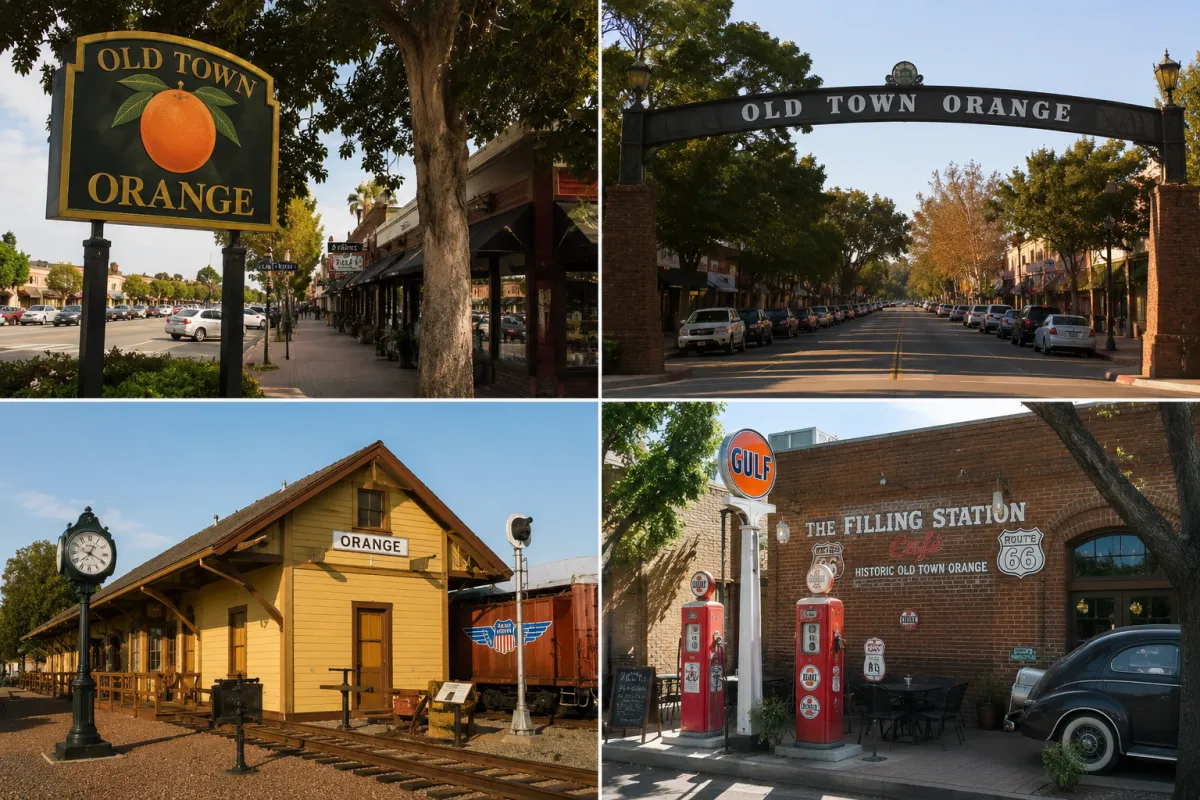
Old Towne Orange (often called “The Orange Circle” or “Old Towne Orange”) is one of the most historically significant downtown districts in California. What makes it unique is that it wasn’t an old town that happened to survive—it was carefully planned from the beginning around a central plaza, and that original design is still visible today.
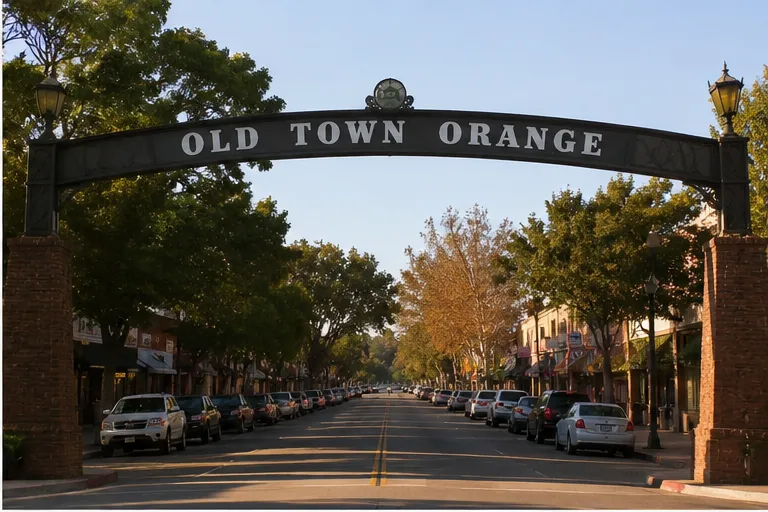
Old Towne Orange was founded in 1871 by two Los Angeles attorneys, Alfred Beck Chapman and Andrew Glassell, who acquired land from Rancho Santiago de Santa Ana. They designed a town centered around a public plaza—a layout inspired by Spanish and Mexican colonial town planning. The community was first called Richland, but in 1873 it was renamed Orange.
Today, Old Towne Orange is:
The largest National Register historic district in California.
Home to roughly 1,400 historic buildings.
One of the best-preserved examples of a late-19th-century California town.
Famous for antique stores, restaurants, filming locations, and its walkable historic downtown.
For thousands of years, the area was inhabited by the Tongva (Gabrielino) people.
In the Spanish and Mexican eras, the land became part of Rancho Santiago de Santa Ana, a large cattle ranch granted by the Spanish Crown and later recognized by Mexico.
After California became part of the United States in 1848, portions of the rancho were sold and subdivided.
How was Orange created?
Chapman and Glassell
In the late 1860s, attorneys Alfred Chapman and Andrew Glassell accepted approximately 1,385 acres of ranch land as payment for legal services. They saw the potential for a new agricultural community and began planning a town.
In 1871, surveyor and Civil War veteran Captain William T. Glassell laid out the town site. The original plan included:
A one-square-mile town grid
A central plaza
Ten-acre agricultural lots surrounding town
Broad streets intersecting at the plaza center
The two main streets were eventually named:
Chapman Avenue
Glassell Street
after the founders.
Why Is There a Circle?
Many people assume the Circle was designed as a traffic roundabout.
It wasn’t.
The town was originally built around a square plaza. The circular roadway developed later around the central park, creating the distinctive traffic circle people know today. Orange became the only city in Orange County planned around a central plaza, earning the nickname “The Plaza City.”
The Name Change: Richland to Orange
Originally the town was named Richland.
When residents applied for a post office in 1873, federal officials rejected the application because another California community already used the name Richland.
The founders chose Orange instead. While local folklore claims the name was selected during a poker game, historians indicate it was chosen largely for promotional reasons because citrus cultivation was becoming closely associated with Southern California.
The Citrus Boom
Orange grew because of oranges.
The fertile soil and irrigation opportunities made the area ideal for citrus agriculture. During the late 1800s and early 1900s, Orange County became one of the nation’s leading citrus-producing regions.
The prosperity generated by citrus farming funded many of the buildings still standing around the plaza today. Banks, hotels, business blocks, churches, and Victorian homes appeared as growers became wealthy.
The Railroad Changed Everything
Orange’s growth accelerated when the railroad arrived.
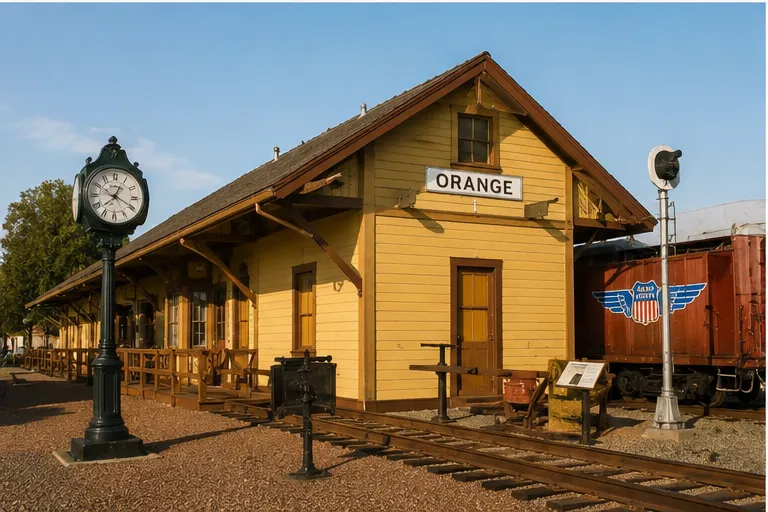
Orange became one of the first developed communities in the county connected to the California Southern Railroad, part of the nation’s second transcontinental rail system. This allowed citrus and agricultural products to reach national markets quickly.
Without the railroad, Orange likely would have remained a small farming settlement.
Creation of the Plaza
The plaza we see today evolved gradually.
In the 1870s, the center of town was reportedly little more than an empty lot. Local merchant Robert Crowder planted trees there, and it became a gathering place for farmers arriving by horse and wagon.
Residents soon wanted something more attractive.
In 1887:
The community formally approved plans for a public park.
Citizens raised money through local fundraisers.
A decorative fountain was installed.
Trees, pathways, flowers, and landscaping were added.
The plaza became the symbolic and social center of the city.
Architectural Treasure
One reason Old Towne Orange is famous today is that so much of it survived.
Unlike many Southern California cities that demolished older neighborhoods during postwar redevelopment, Orange preserved much of its original building stock.
You can find examples of:
Victorian
Craftsman
California Bungalow
Prairie
Mediterranean Revival
Spanish Colonial Revival
Classical Revival
Mission Revival architecture
The district contains around 1,400 historic buildings and represents roughly 50 architectural styles.
Why Old Towne Orange Looks Different Than the Rest of Orange County
Most Orange County cities experienced rapid suburban redevelopment after World War II.
Orange did too—but the original downtown remained largely intact.
As a result, Old Towne Orange feels very different from surrounding communities because:
Streets remain on the original 1871 grid.
The central plaza still exists.
Hundreds of pre-1940 homes survive.
Historic commercial blocks remain in active use.
Walking around the Circle today is surprisingly close to walking around the town center of 100 years ago.
Hollywood’s Favorite Small Town
Because the area still looks like an authentic early-20th-century American town, filmmakers frequently use it as a stand-in for:
Midwest towns
East Coast main streets
Historical settings
Movies and television productions have filmed there for decades.
Fun Facts
Orange is known as “The Plaza City.”
It is the only city in Orange County originally designed around a central plaza.
Old Towne Orange is considered California’s largest historic district.
The annual Orange International Street Fair began in 1973 as part of the city’s centennial celebration.
The Circle’s famous fountain traces its origins to community fundraising efforts in the 1880s.
Why Old Towne Orange Matters
Old Towne Orange is essentially a preserved snapshot of Southern California before freeways, malls, and suburban sprawl. It tells the story of how Orange County transformed from ranchland into one of the fastest-growing regions in America. The plaza, street layout, historic homes, and commercial buildings are all direct descendants of a town plan first sketched onto ranchland in 1871 by Chapman and Glassell.
It’s one of the few places in Southern California where you can still clearly see the original vision of a 19th-century California town.
Orange Shops:
The district includes antique malls, vintage clothing stores, gift boutiques, record shops, home décor stores, galleries, restaurants, coffee shops, salons, and professional services. The City of Orange maintains a business directory because the tenant roster changes regularly.
What makes the Orange Circle unique is that it isn’t a traditional mall. It’s a walkable historic downtown where independent businesses occupy buildings dating back to the late 1800s and early 1900s. The area is especially famous for antiques—so much so that it is often called the “antique capital” of Southern California, with dozens of antique dealers clustered around the Circle.
The backbone of Orange Circle shopping is its antique stores. The largest and most famous include Orange Circle Antique Mall, a sprawling multi-dealer marketplace packed with vintage furniture, records, collectibles, clothing, advertising signs, and décor from nearly every decade. Nearby, Antique Station occupies a former neighborhood grocery store and houses dozens of dealers selling everything from toys and jewelry to furniture and Americana. Across the street, Antique Depot offers another huge collection of antique and vintage vendors inside a historic downtown building.
For shoppers who love curated vintage aesthetics, Elsewhere Vintage has become one of Old Towne’s signature fashion destinations. The shop specializes in authentic vintage clothing and accessories, while its neighboring men’s concept, Joyride Vintage, focuses on classic menswear and retro styles. The store has developed a reputation for carefully selected pieces rather than the treasure-hunt feel of a traditional thrift store.
A newer addition to the district is Groovy Ghost Vintage, which blends vintage clothing, vinyl records, retro décor, Disney collectibles, and pop-culture memorabilia. The store represents the younger side of Old Towne’s vintage scene and has quickly become popular among collectors looking for nostalgic finds from the 1960s through the 1990s.
Garden and farmhouse enthusiasts often gravitate toward Country Roads Antiques, known for its mix of antique furnishings, decorative pieces, reclaimed architectural elements, and outdoor garden treasures. The store has long been one of the Circle’s most recognizable destinations for home decorators and interior designers.
For serious collectors, Golden Bear Antiques and many of the smaller dealer shops scattered around Glassell Street and Chapman Avenue offer specialized collections ranging from fine antiques and vintage art to rare collectibles and historical memorabilia.
Beyond antiques, the Circle is filled with specialty retailers. You’ll find independent bookstores, gift boutiques, artisan shops, record stores, home décor merchants, vintage-inspired lifestyle stores, handmade goods, and locally owned specialty retailers that change frequently as new entrepreneurs move into the historic storefronts. Recent additions include businesses like Garrahan Hat Company and Oak & Poppy, continuing the district’s tradition of locally owned specialty retail.
The overall experience of shopping Old Towne Orange is less about visiting a specific store and more about wandering block by block. Nearly every storefront offers something different, whether that’s mid-century furniture, vintage clothing, vinyl records, collectibles, handcrafted gifts, antiques, home furnishings, artwork, or one-of-a-kind décor. That’s why people often spend an entire afternoon exploring the Circle—it’s one of the few places in Southern California where browsing itself is the attraction.
Navigating the Circle:
The best way to explore Old Towne Orange is as a giant square surrounding Plaza Park. Think of it as four spokes radiating from the Circle: North Glassell, South Glassell, West Chapman, and East Chapman. The exact tenant mix changes every year, but here’s the current “walking tour” version that covers the shops people actually come to see.
Start at the Circle (Plaza Park)
The Circle itself is mostly restaurants and gathering space, but it serves as the anchor for everything around it. Stand in Plaza Park and you’ll see historic brick buildings, the fountain, and storefronts that have been continuously used for decades. This is where most visitors get their bearings before choosing a direction.
North Glassell Street
(The vintage and younger-crowd side)
Walking north from the Circle, the atmosphere shifts toward vintage fashion, collectibles, pop culture, and newer independent retailers. One of the standout stops is Groovy Ghost Vintage, a shop filled with vintage clothing, retro décor, collectibles, vinyl records, and nostalgic pop-culture finds. It feels less like a traditional antique store and more like a curated time capsule from the 1970s through the 1990s.
You’ll also find newer specialty retailers, boutique gift shops, artisan businesses, and locally owned concepts opening along this stretch as Old Towne continues evolving. Recent additions such as Garrahan Hat Company and other independent retailers are helping diversify the district beyond antiques.
This section is usually where younger shoppers spend the most time because it blends vintage culture with contemporary retail.
South Glassell Street
(The antique capital of the Circle)
If North Glassell is trendy, South Glassell is where Old Towne Orange earned its reputation.
The first must-see stop is Orange Circle Antique Mall. This is the flagship antique destination of the district and contains over a hundred dealer spaces spread through a historic building. You can find furniture, records, books, vintage Disney items, jewelry, advertising signs, toys, artwork, and collectibles from virtually every era.
AKA O.C.A.M.
A few steps farther south is Antique Depot. It has a slightly more warehouse-like treasure-hunt feel and is known for large furniture pieces, architectural salvage, collectibles, and decorative antiques.
Continue down the block and you’ll reach Antique Station, another Old Towne institution. Housed in a historic building, it offers dozens of vendors and a broad range of collectibles, vintage décor, toys, books, glassware, and estate pieces.
This stretch alone can easily consume several hours if you enjoy browsing.
West Chapman Avenue
(Farmhouse, home décor, and destination shopping)
Heading west from the Circle you’ll encounter some of the largest and most recognizable antique destinations in Orange.
The centerpiece is Country Roads Antiques. Unlike many antique malls, it has a highly styled presentation with farmhouse furniture, garden décor, vintage architectural pieces, reclaimed wood items, and home-design inspiration. Interior designers frequently shop here because many displays feel like fully decorated rooms.
West Chapman is also where you’ll encounter many of the hidden specialty stores tucked into historic storefronts. These range from home-goods shops and gift boutiques to artisan retailers and design-focused businesses. The street generally attracts people furnishing homes rather than collecting memorabilia.
East Chapman Avenue
(Boutiques, gifts, and local discoveries)
East Chapman tends to be the most eclectic section. Here you’ll find a mixture of gift stores, apparel boutiques, lifestyle retailers, specialty food shops, and locally owned businesses.
One of the fun aspects of East Chapman is that the stores rotate more frequently than the antique-heavy sections. You’ll often discover new boutiques, handmade goods, seasonal retailers, and unique concepts that didn’t exist a year earlier. It’s less about hunting for antiques and more about finding something you didn’t know you wanted.
Hidden Side Streets
Many visitors never explore Lemon Street, Olive Street, and the smaller lanes surrounding the Circle.
That’s a mistake.
Some of the best finds are tucked into side-street storefronts, including smaller vintage clothing shops, estate jewelry dealers, art galleries, collectible stores, and specialty retailers. Several longtime businesses have operated quietly off the main corners for years and are known mostly by locals and serious antique hunters.
Famous Circle Food:
Food:
If you’re only in Old Towne Orange once, don’t just eat at random. There are a handful of dishes that locals talk about over and over, and they represent the best of what the Circle does well.
For Mexican food, my first stop would be Gabbi’s Mexican Kitchen. This is not typical combo-plate Mexican food. The menu focuses on regional Mexican flavors and elevated ingredients. Order the cochinita pibil, duck carnitas, or one of their creative tacos. It’s one of the restaurants most responsible for putting Old Towne Orange on Orange County’s foodie map.
For seafood, O Sea is arguably the most acclaimed restaurant in the district. The spicy tuna crispy rice, salmon ceviche, and black cod are standout dishes. The menu changes regularly based on what’s fresh, which is part of the appeal.
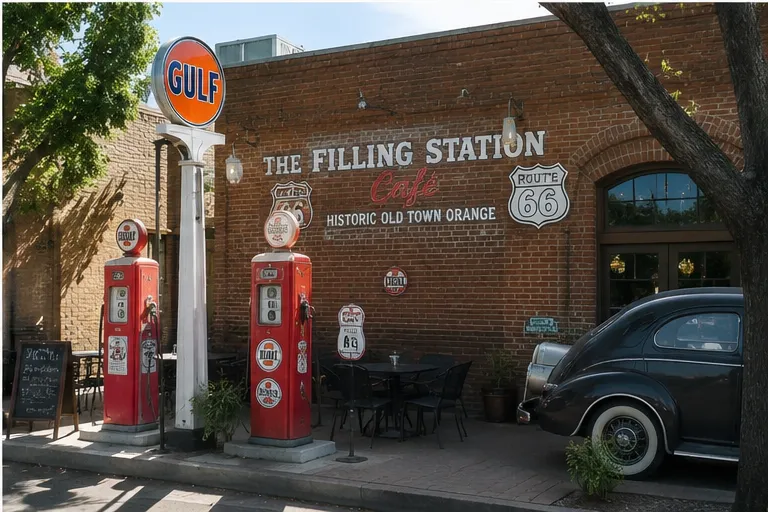
For brunch, locals swear by The Filling Station Cafe. The must-order item is the massive pancakes, although the breakfast potatoes and eggs Benedict are also favorites. It’s one of those places where you expect a 20-minute wait on weekends.
If you’re a burger person, head to Bosscat Kitchen & Libations and order the Bosscat Burger. Pair it with one of their whiskey selections. Bosscat has become one of the busiest restaurants in the Circle because it balances upscale food with a relaxed atmosphere.
For craft food and drinks, Haven Craft Kitchen + Bar is one of Orange County’s pioneering farm-to-table restaurants. The menu rotates frequently, but the focus is always seasonal California ingredients, craft beer, and creative comfort food.
If you want something casual after antique shopping, Finney’s Crafthouse - Orange is known for burgers, Buffalo cauliflower, loaded tots, cheesesteak egg rolls, and a great beer list. It’s become one of the most popular gathering spots on Chapman Avenue.
For breakfast and coffee, don’t miss Cafe Zocalo. The outdoor patio is one of the prettiest spots in the Circle, and their breakfast burritos, chilaquiles, and pastries are excellent.
For a classic Old Towne Orange experience, Felix Continental Cafe remains a local institution. The Cuban dishes, plantains, and outdoor patio have been drawing people for decades.
My Perfect Old Town Orange Day:
If You Only Have Two Hours
Start at Plaza Park.
Walk south on Glassell through: Orange Circle Antique Mall, Antique Depot, Antique Station
Double back and head west to: Country Roads Antiques
Finish north of the Circle at: Groovy Ghost Vintage
The deep assurance that comes from full alignment
LEARN ABOUT OTHER FAMOUS OLD TOWNS: Old Town San Diego, Old Towne Orange, Old Town San Clemente, Old Town Monrovia, Old Town Temecula, Old Town Pasadena, Old Town Sacramento, Old Town Bern, Old Town Stockholm, Old Town Prague, Old Town Lijiang, Old Town Alexandria, Old Town Albuquerque, Old Town Cottonwood, Old Town Quedlinburg, Old Town Rothenburg ob der Tauber, Old Town Marienplatz Munich, Flipside Point, Alexanderplatz Old Town Berlin, Old Town Chicago, Old Town Kissimmee Florida, Phuket Old Town, Old Town Asakusa, Old Town Madrid Major Square, Kraków Old Town, Old Town London Piccadilly Circus,
This is a Paragraph Font
~ SPAGHETTI WESTERN QUOTE:
“Courage is being scared to death and saddling up anyway!” – John Wayne
Visit Us At:
OLD TOWN SAN CLEMENTE
~ A Little Spanish Spaghetti Western Old Town ~
111 W. Avenida Palizada, San Clemente, CA 92672
"Thanks For Being Incredible!"
GREAT ARTICLES: Best places to eat, History of Del Mar Street, History of San Clemente Outlets, History of T-Street Beach,
History of the Pier, History of Cars and Coffee, History of Los De Juarez Burritos, History of the Smash Burger, History of Sourdough Bread, History of Sourdough Cookies, History of Sushi,
This website is owned and operated by (c) 2025 - University of San Clemente Inc.