All about the Historic T-Street Beach!
T Street Beach (also known as T-Street or sometimes Esplanade Beach) is a beloved, accessible surf and family beach in San Clemente, California, located about 0.5 miles south of the historic San Clemente Pier. It sits at the western end of Esplanade Street near the “T” intersection with Paseo de Cristobal (with access tied to Trafalgar Canyon). It features consistent waves, a mix of beach break and small rock reef, and serves as a quintessential Southern California “Endless Summer” spot—reliable when other breaks are flat, popular with locals (“waterpeople”), bodyboarders, and surfers of various levels. 
Pre-History and Indigenous Roots
The coastal area was long used by the Acjachemen (also known as Juaneño) people, who lived in villages near the coast and relied on the ocean for fishing, shellfish gathering, and resources long before European contact.
Spanish exploration reached the broader region in the 1600s. In 1602, explorer Sebastián Vizcaíno named San Clemente Island (after Pope Clement I); the future city took its name from the island in 1925.
During the Mexican era, the land fell under large ranchos, including parts of Rancho Boca de la Playa (northern sections) and Rancho Los Desechos. After the American conquest (1848) and land transfers, the area remained largely undeveloped ranch and coastal land into the early 20th century. In 1906, it was sold to the Goldschmidt brothers, who planned vineyards.
Founding and How T-Street Beach Came to Be (1920s)
In 1925, former Seattle mayor Ole Hanson purchased roughly 2,000 acres and created one of America’s first master-planned communities—“San Clemente by the Sea” or the “Spanish Village by the Sea.” He envisioned a clean, Mediterranean-style resort town with white walls and red tile roofs (enforced initially via architectural review), capitalizing on the climate, beaches, and rail access. The first property sales occurred on December 6, 1925; the city incorporated on February 28, 1928. 
Beaches were central to Hanson’s vision. He funded public amenities including the San Clemente Pier (originally built ~1928, about 1,200 feet long) to draw tourists and residents. T-Street developed as one of the key southern beach accesses near the pier, using the natural topography of Trafalgar Canyon (which runs from El Camino Real nearly to the water) and the street grid. The name “T-Street” or “T-Street Beach” derives primarily from Trafalgar Canyon, with the prominent “T”-shaped intersection (Esplanade and Paseo de Cristobal) and pedestrian overpass reinforcing the moniker. 
The existing coastal railroad (now used by Amtrak/Metrolink) runs right along the bluff, so safe public access required stairs or a pedestrian overpass/bridge—still a defining feature today. Early development included basic beach access points, with the pier and nearby areas promoting the resort lifestyle. The Great Depression slowed sales, but the community and its beaches took root.
Evolution Through the Decades and Key Events
1920s–1930s: Initial boom with the pier’s construction and early Spanish Colonial Revival homes on the bluffs. Beaches saw growing but still relatively quiet use. In 1939, severe storms heavily damaged the pier (it was rebuilt), highlighting the power of Pacific storms on the exposed coastline.
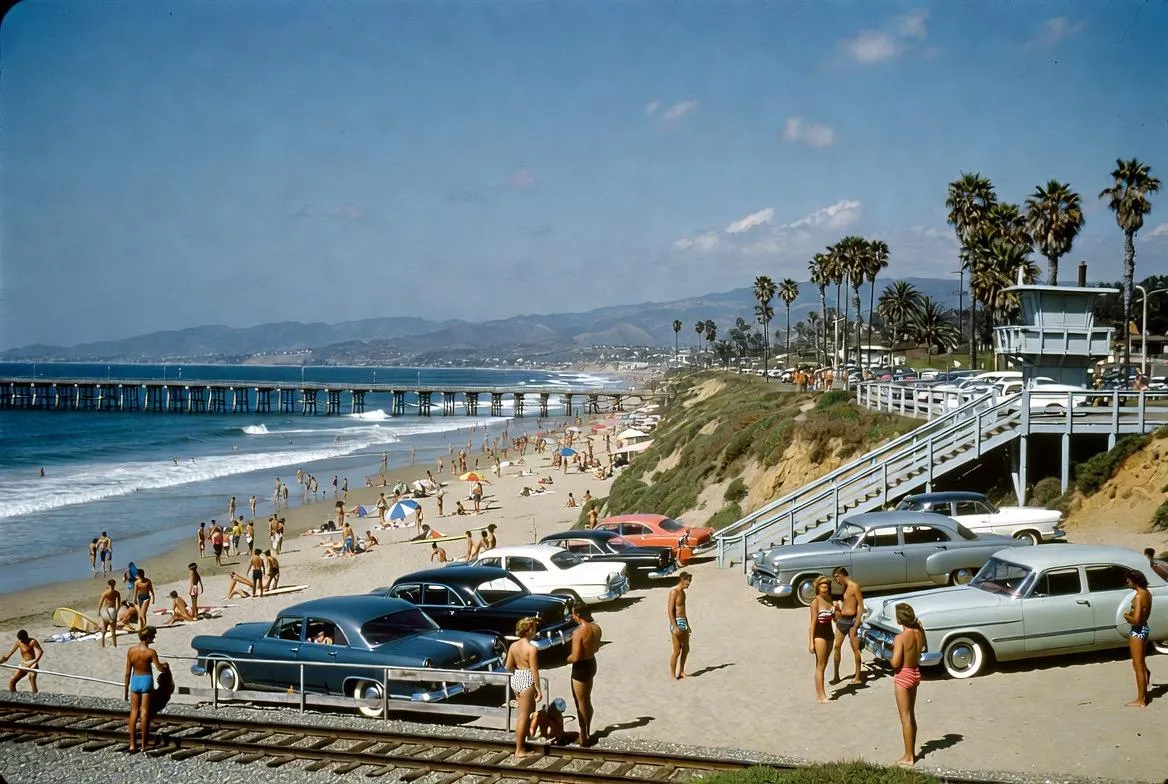
1940s–1950s: Post-WWII suburban and population boom transformed San Clemente. T-Street and nearby beaches became popular family destinations with more cars, parking improvements, and classic mid-century California beach culture (swimwear, umbrellas, emerging lifeguard presence). Surfing began gaining a foothold locally.
1960s–1970s: The surfing era exploded. T-Street earned a reputation as one of the most consistent waves in the region—a dependable beach/reef break good for quick sessions or when other spots (like Trestles to the south) were flat. It became a local favorite for its fun, rideable waves. The area’s profile rose further when President Richard Nixon purchased La Casa Pacifica (“Western White House”) nearby in 1969; world leaders visited the region, and Trestles gained international fame. Beach scenes featured longboards transitioning to shortboards, VW vans, and a laid-back surf vibe.
1980s: Another major storm in 1983 damaged the pier again (rebuilt with wooden structure elements around 1985; later renovations followed). Infrastructure like the pedestrian overpass was refined for safety. Surf culture remained strong.
1990s–Present: T-Street matured into a well-equipped city beach with restrooms, showers, picnic tables/palapas, fire rings (seasonal), concessions, lifeguards (when busy), metered parking, and integration into the San Clemente Beach Trail (a scenic coastal path). The Spanish Village aesthetic persists in historic pockets, while modern homes and amenities blend in. It hosts local surf events, including amateur series (e.g., Am Slam) and fun contests like Red Bull Foam Wreckers (soft-top only). Coastal management addresses erosion from storms and El Niño events, common to California beaches. Today it balances families, tourists, and dedicated surfers/bodyboarders.
No single catastrophic event is tied exclusively to T-Street (unlike the pier’s storm damage), but it shares the region’s history of storm impacts, railroad-influenced access, and surfing heritage. It has remained a reliable, community-oriented beach rather than a heavily commercialized one.
Late 1920s / Early Development Era (shortly after founding and pier construction — sparse, resort vision taking shape with early access and Spanish-style elements on the bluffs)
1950s Post-War Boom (classic California beach scene with families, classic cars, emerging facilities, lifeguard presence, and lively but not overcrowded sand)
1970s Surf Culture Peak (energetic local surf scene with boards, casual beachgoers, VW vans, and the pier backdrop — quintessential “Endless Summer” energy)
Late 1990s / Early 2000s (established palm trees, mix of visitors and surfers, parking, and the maturing coastal environment with the pier prominent)
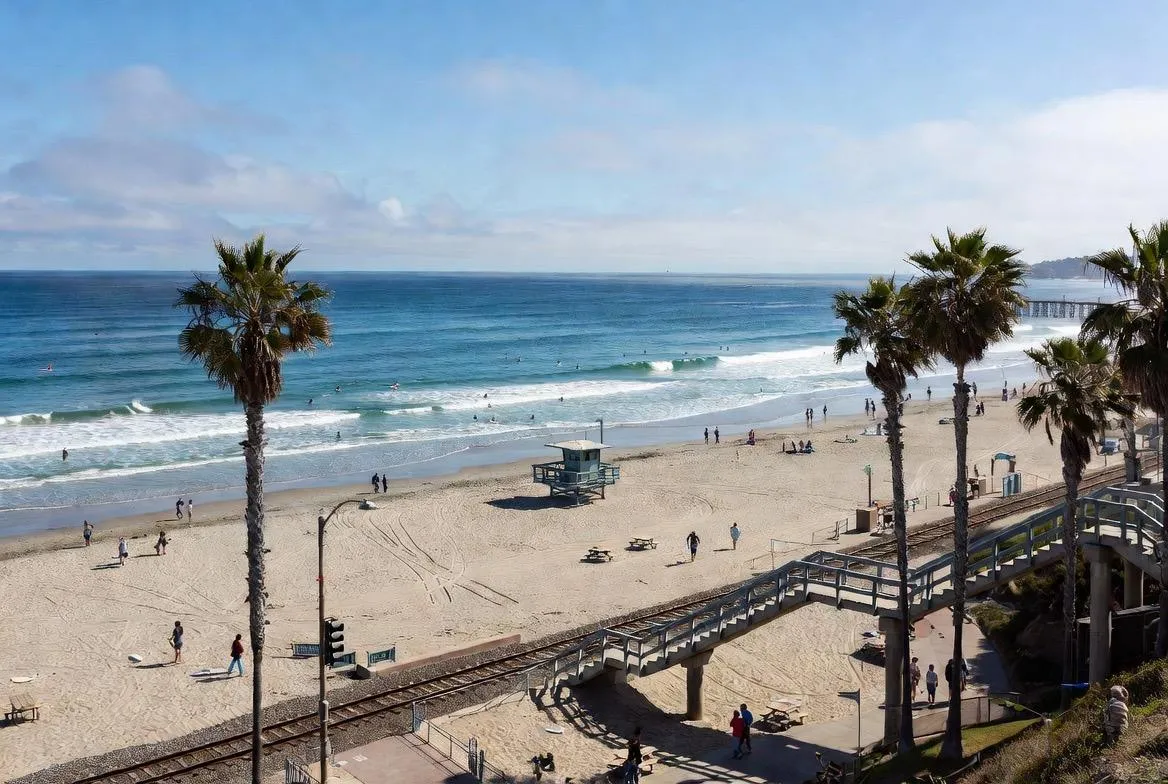
Modern Day (Present) (current look with the key pedestrian overpass/bridge for safe railroad crossing, lifeguard tower, palms, trail access, surfers in the water, and the pier in view — vibrant and well-used)
T-Street remains a cherished local gem—consistent waves, easy(ish) access despite the tracks, and that perfect blend of surf spot and relaxed beach day destination. Its story is deeply woven into San Clemente’s identity as a planned coastal paradise that grew into a surfing and lifestyle hub.
The deep assurance that comes from full alignment
LEARN ABOUT OTHER FAMOUS OLD TOWNS: Old Town San Diego, Old Towne Orange, Old Town San Clemente, Old Town Monrovia, Old Town Temecula, Old Town Pasadena, Old Town Sacramento, Old Town Bern, Old Town Stockholm, Old Town Prague, Old Town Lijiang, Old Town Alexandria, Old Town Albuquerque, Old Town Cottonwood, Old Town Quedlinburg, Old Town Rothenburg ob der Tauber, Old Town Marienplatz Munich, Flipside Point, Alexanderplatz Old Town Berlin, Old Town Chicago, Old Town Kissimmee Florida, Phuket Old Town, Old Town Asakusa, Old Town Madrid Major Square, Kraków Old Town, Old Town London Piccadilly Circus,
This is a Paragraph Font
~ SPAGHETTI WESTERN QUOTE:
“Courage is being scared to death and saddling up anyway!” – John Wayne
Visit Us At:
OLD TOWN SAN CLEMENTE
~ A Little Spanish Spaghetti Western Old Town ~
111 W. Avenida Palizada, San Clemente, CA 92672
"Thanks For Being Incredible!"
GREAT ARTICLES: Best places to eat, History of Del Mar Street, History of San Clemente Outlets, History of T-Street Beach,
History of the Pier, History of Cars and Coffee, History of Los De Juarez Burritos, History of the Smash Burger, History of Sourdough Bread, History of Sourdough Cookies, History of Sushi,
This website is owned and operated by (c) 2025 - University of San Clemente Inc.