All about the History of Sushi!
Sushi did not start as raw fish on rice. It started as a way to keep freshwater fish from rotting. The rice was packing, then trash. Japan turned the packing into the meal, then into street food, then into a global counter.
Preservation, not a restaurant dish
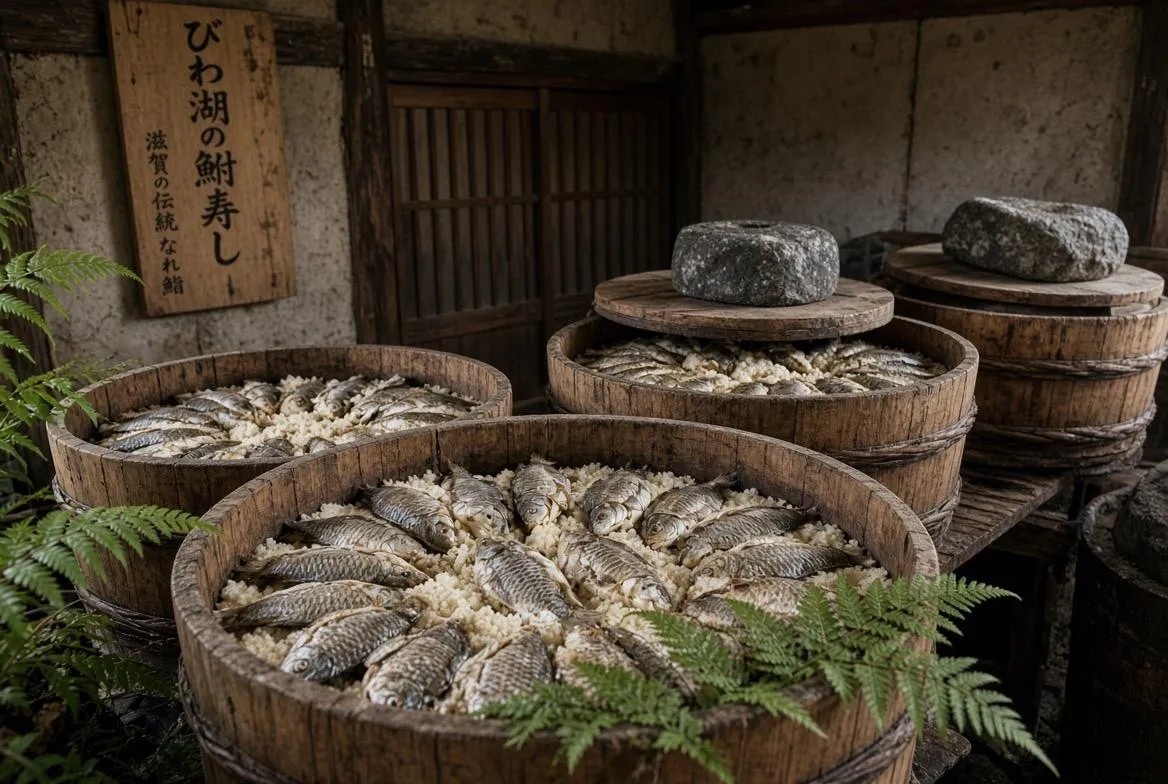
The ancestor is narezushi: gutted fish packed with salt and cooked rice, weighted in a barrel, left for months or years. Lactic fermentation sour the fish and keep it edible through lean seasons. The rice turns to sludge and is thrown away. Only the fish is eaten.
That method is older than Japan’s written record. Related dishes still exist across the Mekong and southern China—pla som in Thailand, phaak in Cambodia, yuzha in Hunan. Scholars place the idea in inland Southeast Asia or southern China, then moving with wet-rice farming. In Japan it likely arrives with Yayoi rice agriculture. The characters 鮨 and 鮓 appear as imperial tribute in the Yōrō Code of 718. Tenth-century Engishiki lists regional narezushi, including funazushi (crucian carp from Lake Biwa) and ayu sushi. Funazushi is still made around Lake Biwa: salt-cure, then a year or more in rice under stones. It smells sharp. Bones soften. It is the living fossil of the dish. 
The word sushi comes from an old adjective for sour. The sour was fermentation, not a bottle of rice vinegar.
Eating the rice: namanare to hayazushi
By the Muromachi period (1336–1573) people shorten the wait and eat the rice with the fish. That is namanare (“partially fermented”). In the Edo period, rice vinegar becomes common enough to fake the acid. Hayazushi (“fast sushi”) skips months of barrels. Vinegared rice plus fish, ready the same day.
Osaka and Kyoto keep oshizushi / hakozushi: layers pressed in a box, sliced. Rolled makizushi appears around the early 1800s. None of this is yet the oval of rice you pick up with two fingers.
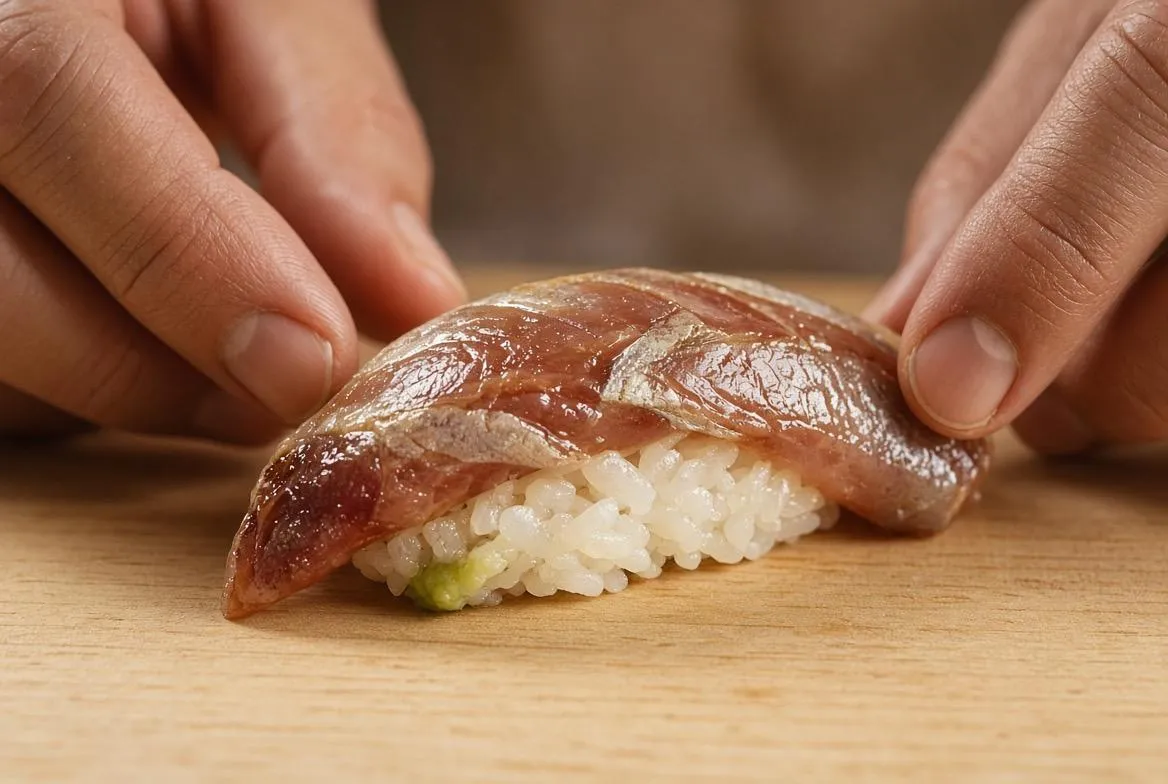
Edo fast food: nigiri
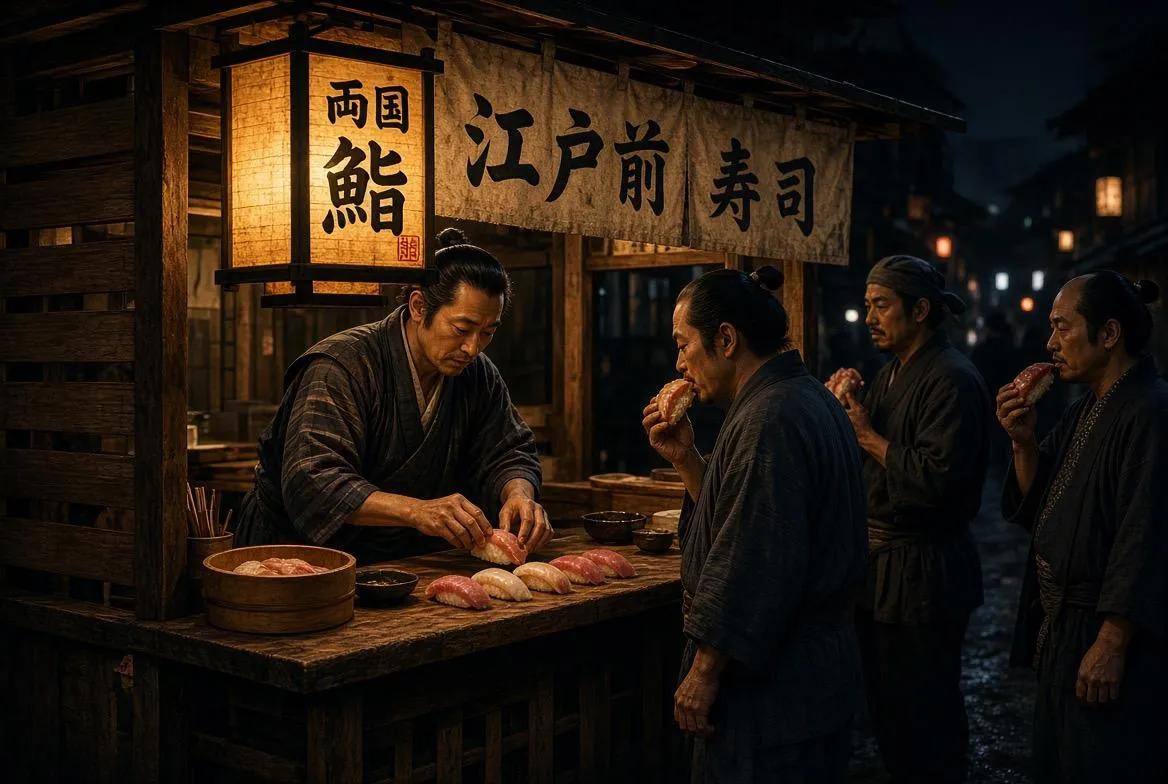
Edo (Tokyo) in the early 1800s is a million-person city of laborers, firemen, and single men. Soba, tempura, and sushi sell from yatai stalls. People want food they can eat standing.
Hanaya Yohei (1799–1858) is the name attached to popularizing nigirizushi in Ryōgoku around the Bunsei era (1818–1830); he opens a shop in 1824. He is not proven to be the unique inventor—family records even mention earlier failed attempts—but he is the man who made hand-formed pieces the city’s style. Rice is seasoned with vinegar and salt, squeezed by hand, topped with seafood from Edomae—literally “in front of Edo,” Tokyo Bay. Pieces were two or three times larger than today’s. Fish was often cooked, vinegared, or soy-marinated. Raw fatty tuna belly spoiled too fast; lean akami was dipped in soy. Wasabi between rice and fish is credited to this milieu. A senryū poem of the time compares the hand-press to a conjurer’s trick. 
This was not omakase. It was street food for impatient edokko. During the Tenpō famine and reforms of the 1830s–40s, sushi stalls were treated as luxury and some chefs were arrested. The crackdown did not last.
Refrigeration, ice, and later air freight change the topping list. Salmon, now a sushi default in the West, was not an Edo nigiri fish; parasites made raw Pacific salmon unsafe until freezing protocols. Toro becomes a luxury only when fat can be kept cold.
Japan after Edo
The Great Kantō Earthquake (1923) and World War II break old shops. Postwar counters in Ginza rebuild from Edo lineages (Yohei, Senju Miyako, Futaba). Conveyor-belt sushi is a separate invention: Yoshiaki Shiraishi, short-staffed in Higashi-Osaka, watches beer bottles on an Asahi line and opens Mawaru Genroku Sushi in 1958. The belt runs clockwise so right-handed diners grab with the left. Expo ’70 in Osaka shows it to the world. The patent expires; chains follow. 
Abroad
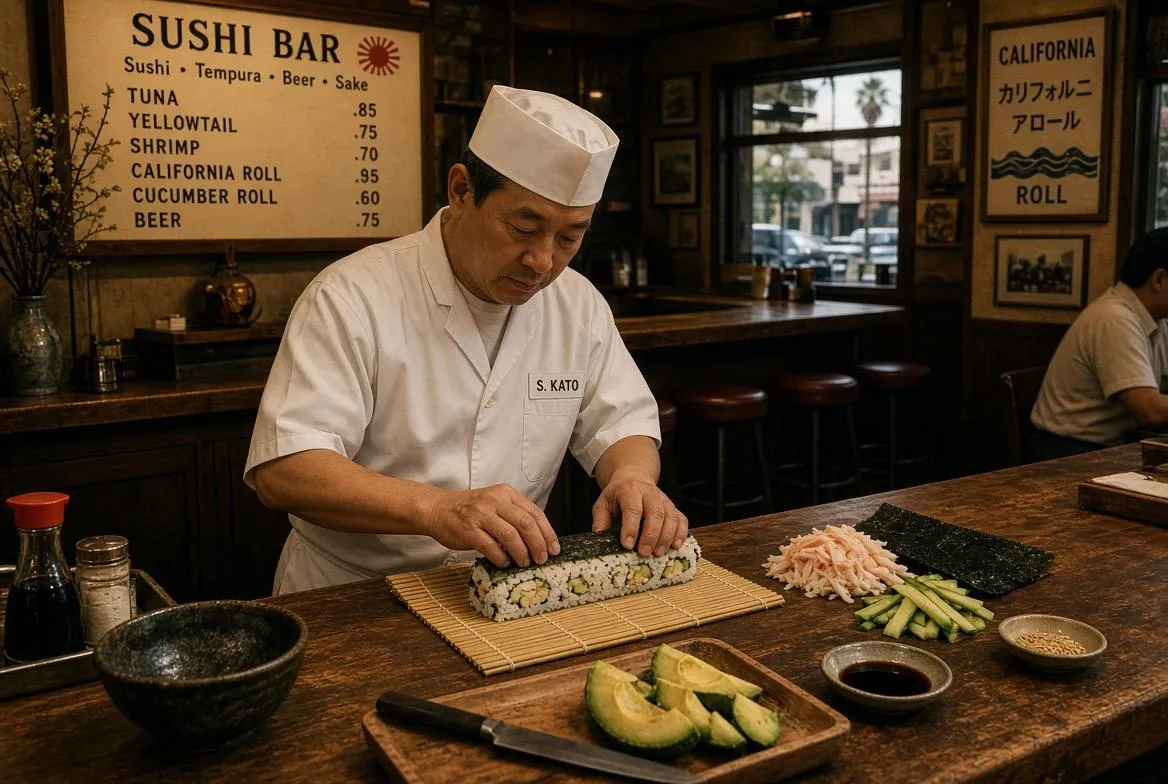
Japanese immigrants serve sushi in the U.S. early in the 20th century (San Francisco, then L.A.’s Little Tokyo). Internment in 1942 shuts most West Coast Japanese businesses. After the war, Kawafuku in Little Tokyo (mid-1960s) is widely cited as the first modern American sushi bar. Hollywood follows when Osho opens near the Fox lot.
The California roll is an American adaptation, not an Edo recipe. Credit is disputed: Ichiro Mashita at Tokyo Kaikan in L.A. (avocado for off-season toro, crab, later inside-out so nori is hidden), Hidekazu Tojo in Vancouver, and a 1979 AP story naming Ken Seusa. First print uses of the name appear in 1979. The roll exists to get diners past raw fish and visible seaweed. It works. Global sushi after that is a mix of Edo nigiri, maki, and local inventions (spicy tuna, Philadelphia roll).
Timeline written out
Before Japan. Inland Southeast Asia / southern China: fish fermented with rice and salt; rice discarded.
Yayoi–Nara. Method travels with rice farming. 718: sushi characters listed as tribute.
10th century. Engishiki records regional narezushi, including Lake Biwa carp.
Muromachi. Namanare: shorter ferment, rice eaten.
1600s–1700s. Vinegar makes hayazushi. Box-pressed sushi in Kansai.
c. 1818–1824. Nigiri popularized in Edo; Yohei’s stall and shop in Ryōgoku. Edomae fish, large hand-pressed pieces.
1830s–40s. Sumptuary crackdown on sushi stalls.
1958. First kaitenzushi, Higashi-Osaka.
1965–67. Modern U.S. sushi bar in Little Tokyo; California roll experiments in L.A. (and later Vancouver claim).
1970. Osaka Expo spreads conveyor sushi.
1979. “California roll” in American newspapers.
The through-line is speed. Months in a barrel become a day with vinegar, then a minute at a stall, then a plate on a belt. Funazushi still takes a year. That is the same word covering two different foods.
The deep assurance that comes from full alignment
LEARN ABOUT OTHER FAMOUS OLD TOWNS: Old Town San Diego, Old Towne Orange, Old Town San Clemente, Old Town Monrovia, Old Town Temecula, Old Town Pasadena, Old Town Sacramento, Old Town Bern, Old Town Stockholm, Old Town Prague, Old Town Lijiang, Old Town Alexandria, Old Town Albuquerque, Old Town Cottonwood, Old Town Quedlinburg, Old Town Rothenburg ob der Tauber, Old Town Marienplatz Munich, Flipside Point, Alexanderplatz Old Town Berlin, Old Town Chicago, Old Town Kissimmee Florida, Phuket Old Town, Old Town Asakusa, Old Town Madrid Major Square, Kraków Old Town, Old Town London Piccadilly Circus,
This is a Paragraph Font
~ SPAGHETTI WESTERN QUOTE:
“Courage is being scared to death and saddling up anyway!” – John Wayne
Visit Us At:
OLD TOWN SAN CLEMENTE
~ A Little Spanish Spaghetti Western Old Town ~
111 W. Avenida Palizada, San Clemente, CA 92672
"Thanks For Being Incredible!"
GREAT ARTICLES: Best places to eat, History of Del Mar Street, History of San Clemente Outlets, History of T-Street Beach,
History of the Pier, History of Cars and Coffee, History of Los De Juarez Burritos, History of the Smash Burger, History of Sourdough Bread, History of Sourdough Cookies, History of Sushi,
This website is owned and operated by (c) 2025 - University of San Clemente Inc.